
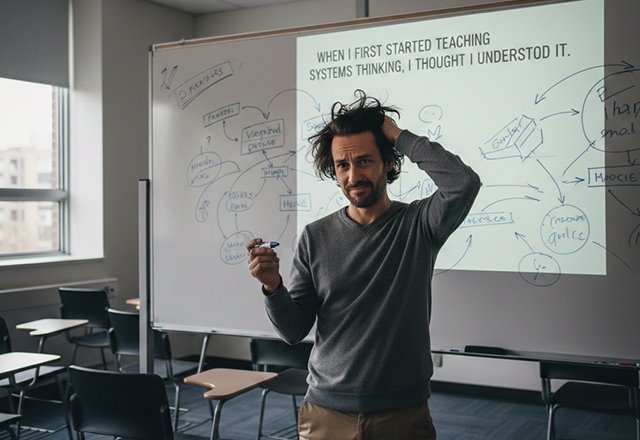
I knew the diagrams, the theory, the language — loops, leverage points, feedback. I had read books and articles, including the one that stuck with me most: “Dancing with Systems” by Donella Meadows. It was elegant and wise she spoke of systems like living beings you could learn to move with, not control. But still, it felt abstract… until it wasn’t.
Let me take you into the classroom. Not a traditional one my learners are mature professionals, juggling work, families, and ambitions. They come from community charities, health services, local councils the kind of people who don’t have time for theory unless it works. Unless it helps.
One day, during a session on partnerships, a learner said:
“It’s not that we don’t care. It’s that we’re all stuck in our own bit of the system, trying to stay afloat.”
That landed hard.
I paused the slides.
We started mapping what “stuck” looked like. We drew circles for organisations, arrows for power and funding. We added broken communication lines. We added culture, ego, fear, targets, data silos. By the end, the whiteboard looked messy but everyone saw it: we weren’t failing because we were bad at our jobs. We were failing because the system was perfectly designed to give us those results.
That was the moment Systems Thinking became real for me — not as a subject to teach, but as a mindset to live.
What Changed?
I stopped looking for “fixes” and started looking for patterns. I became more patient with tension — it was telling me something. I saw that in every partnership, what’s not being said is just as important as what is. I learned that relationships, trust, and even resistance are data, too.
And in my own practice, I let go of the pressure to be the expert in the room. I became a facilitator of systems seeing. I now open sessions with stories instead of slides, and I invite learners to bring their own systems into the space.
Because the truth is, Systems Thinking can’t be “delivered.”
It has to be discovered together through questions, through reflection, through the mess.
My One Lesson?
- Systems Thinking isn’t about control.
- It’s about noticing. Listening.
- It’s about stepping back far enough to say,
- “Ah, that’s why we keep ending up here. And maybe, just maybe here’s how we change it.”
- If you’re navigating complex work, or partnerships that feel like you’re pushing water uphill, I invite you to dance with your system.
Not fix it.
Not fight it.
Just start by seeing it.
Really seeing it.
And that, perhaps, is where transformation begins.